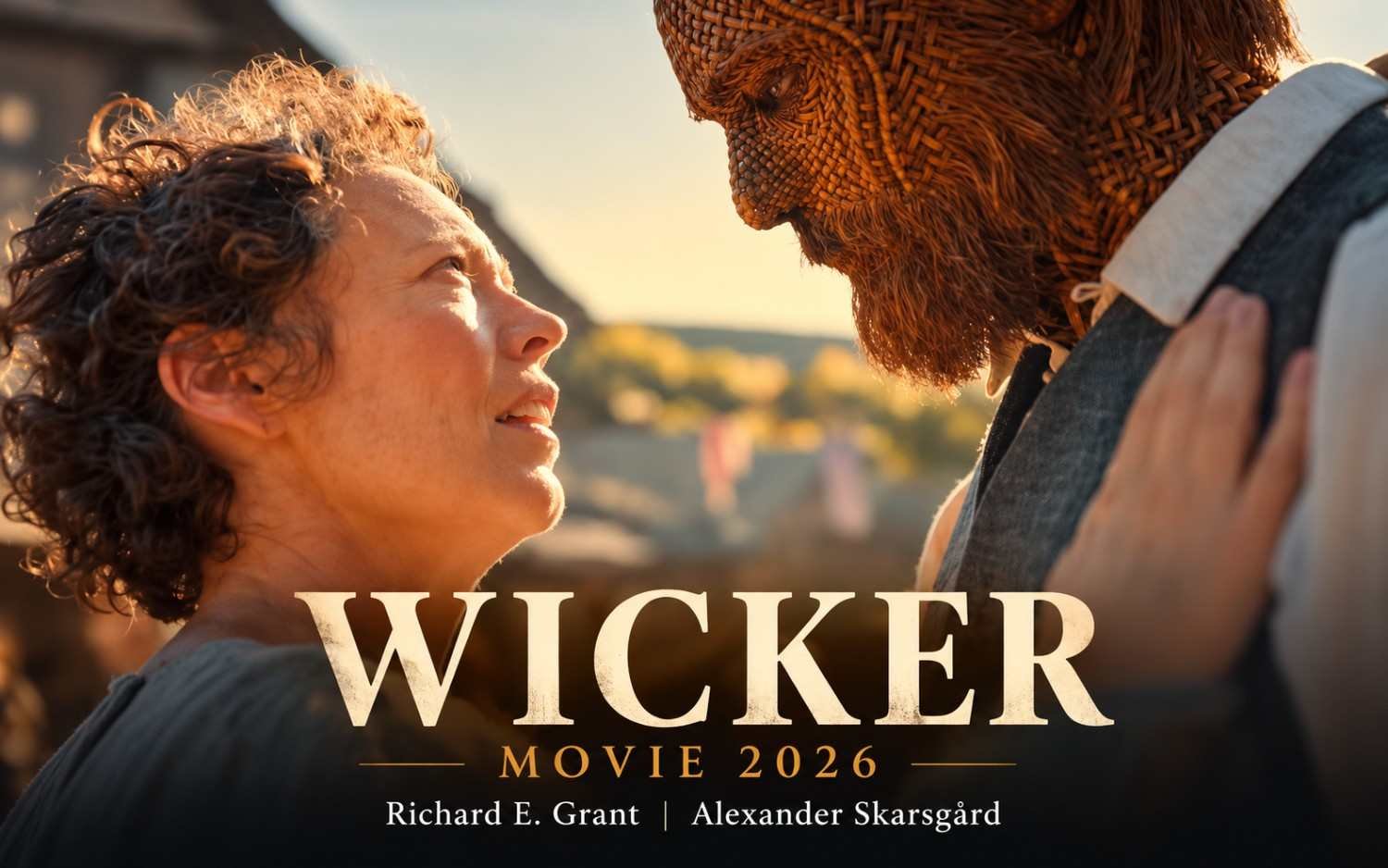
Wicker – Movie 2026 | Richard E. Grant | Alexander Skarsgård
Movie Details
| Category | Details |
|---|---|
| Movie Name | Wicker |
| Director | Alex Huston Fischer and Eleanor Wilson |
| Writers | Alex Huston Fischer and Eleanor Wilson |
| Based On | The Wicker Husband by Ursula Wills-Jones |
| Lead & Supporting Cast | Olivia Colman, Alexander Skarsgård, Peter Dinklage, Elizabeth Debicki, Marli Siu, Nabhaan Rizwan, Richard E. Grant, Ella Bruccoleri, Ben Ashenden, Kiell Smith-Bynoe, Gustav Lindh, Anders Olof Grundberg, Emily Lloyd-Saini, Scott Alexander Young, Daniel Bellus |
| Genre | Romance, Fantasy, Comedy, Drama |
| Language | English |
| Runtime | 105 minutes |
| Theatrical Release | October 23, 2026 |
| Wide Release | October 30, 2026 |
| Distributor | Black Bear |
| Rating | 4/5 Stars |
Wicker – Movie 2026 | Richard E. Grant | Alexander Skarsgård
Introduction & Overview
Wicker is one of the more unusual romantic fantasy films of 2026, presenting a love story that combines whimsical fantasy, dark comedy, village satire, romance, and fairy-tale storytelling. Directed by Alex Huston Fischer and Eleanor Wilson, the film takes the simple human desire for companionship and gives it an extraordinary twist: what if a lonely woman could commission someone to literally make her a husband?
The answer is the film’s central character, the remarkable Wicker Husband, played by Alexander Skarsgård. His existence begins with an unconventional request from an ostracized fisherwoman, portrayed by Olivia Colman, who has become tired of being mocked and excluded by the conservative seaside community around her.
She turns to a local basketmaker, played by Peter Dinklage, and asks him to create a husband for her out of wicker.
What follows is far more complicated than a simple fantasy romance. Once the wicker creation becomes part of the village, his unusual nature challenges the community’s assumptions about marriage, appearance, identity, and social status.
The film’s greatest appeal lies in its willingness to be strange. Wicker is not a conventional love story, nor is it a straightforward fairy tale. It uses an absurd premise to explore surprisingly recognizable emotions.
Detailed Plot Summary
The story takes place in a small seaside village where tradition and social expectations dominate everyday life. At the center of this community is a fisherwoman, a lonely woman who has been pushed to the margins of village society.
She is considered undesirable by the people around her, and her unmarried status becomes a constant source of ridicule. Rather than accepting the judgment of her neighbors, she decides to take an extraordinary step.
She approaches the local basketmaker, played by Peter Dinklage, and commissions him to create a husband for her.
The request sounds impossible, but within the film’s magical world, the impossible becomes reality.
The basketmaker creates a human figure from wicker, and this extraordinary creation eventually comes to life. The role is played by Alexander Skarsgård, whose physical presence and deliberately unusual performance become central to the film’s identity.
The Wicker Husband is not merely a lifeless construction. He possesses personality, intelligence, emotions, and a surprisingly strong sense of morality.
His arrival completely changes the fisherwoman’s life.
For the first time, she has someone who appears to value her for who she actually is rather than judging her according to the superficial standards of the village.
However, the new relationship quickly creates problems.
The villagers are accustomed to traditional ideas about relationships and social status. The appearance of an unconventional husband challenges those beliefs, and the couple’s happiness begins to attract jealousy, suspicion, ridicule, and resentment.
The Wicker Husband also proves to be far more extraordinary than anyone expected. His behavior and outlook challenge the assumptions of the people around him, making him simultaneously fascinating and threatening to the established social order.
The story gradually develops from a whimsical romance into a broader examination of acceptance and prejudice.
Without revealing the film’s major developments, the central conflict emerges from the contrast between the couple’s unconventional relationship and the village’s rigid expectations.
The fisherwoman wants something very simple: companionship, affection, and the opportunity to be loved without judgment.
Yet the community repeatedly attempts to define what a proper relationship should look like.
This creates the film’s emotional foundation. Beneath its fantasy premise, Wicker is ultimately concerned with the universal desire to be accepted.
Cast Performances & Character Breakdown
Olivia Colman as the Fisherwoman
Olivia Colman provides the emotional center of Wicker as the unnamed fisherwoman.
The character could easily have been played as a simple comic figure, but Colman gives her considerable emotional depth.
She portrays a woman who has become accustomed to rejection. The fisherwoman is not merely lonely; she has been made to feel that loneliness is somehow her fault.
Colman’s performance captures the character’s mixture of frustration, vulnerability, determination, and humor.
Her decision to commission a wicker husband is simultaneously ridiculous and heartbreaking. It demonstrates just how deeply she wants companionship while also showing her refusal to continue accepting the village’s judgment.
The actress brings warmth to the character without removing her imperfections. That balance makes the romance considerably more convincing.
Alexander Skarsgård as the Wicker Husband
Alexander Skarsgård takes on perhaps the strangest role of his career as the titular Wicker Husband.
The character presents an unusual acting challenge because Skarsgård has to portray someone who is physically made from wicker while still communicating humanity and emotion.
His performance relies heavily on physicality. Movements, posture, expressions, and controlled gestures become important tools for communicating the character’s personality.
Rather than turning the Wicker Husband into a joke, Skarsgård gives him an unexpectedly gentle quality.
The character is morally straightforward, emotionally intelligent, and sincere. This makes him an interesting contrast to many of the villagers, whose supposedly civilized behavior often reveals greater cruelty and prejudice.
Skarsgård’s performance is therefore central to the film’s unusual charm.
Peter Dinklage as the Basketmaker
Peter Dinklage plays the basketmaker responsible for creating the Wicker Husband.
His character occupies an important position within the story because he is the person who makes the impossible request possible.
Dinklage brings his characteristic mixture of intelligence, humor, and eccentricity to the role.
The basketmaker is not simply a craftsman. His work becomes an important part of the film’s exploration of creation, identity, and human desire.
His relationship with the fisherwoman also adds another layer to the story because he understands the loneliness behind her unusual request.
Elizabeth Debicki
Elizabeth Debicki is another significant presence in the ensemble.
Her character contributes to the social structure of the village and helps illustrate the rigid expectations governing the community.
Debicki’s elegant screen presence creates an interesting contrast with the film’s intentionally rustic and whimsical setting.
Richard E. Grant
Richard E. Grant plays the eccentric and incompetent village doctor, bringing another dose of humor to the strange community.
Grant’s performance fits naturally into the film’s heightened world. His character represents another example of how the village’s supposedly respectable institutions are not necessarily as competent or sensible as they appear.
His eccentricity contributes to the movie’s comic tone while also strengthening its fairy-tale atmosphere.
Supporting Cast
The supporting ensemble includes Marli Siu, Nabhaan Rizwan, Ella Bruccoleri, Ben Ashenden, Kiell Smith-Bynoe, Gustav Lindh, Anders Olof Grundberg, Emily Lloyd-Saini, Scott Alexander Young, and Daniel Bellus.
Together, these actors create a colorful village community filled with characters who react differently to the unusual romance.
Their reactions are important because the film is not only about two people falling in love. It is also about how a community responds when someone refuses to follow its rules.
Direction, Screenplay & Technical Aspects
Direction by Alex Huston Fischer and Eleanor Wilson
Alex Huston Fischer and Eleanor Wilson bring a distinctive visual and tonal identity to Wicker.
The directors understand that the premise requires a delicate balance. If the film became too serious, the concept could lose its whimsical charm. If it became purely comedic, the emotional foundation of the romance could disappear.
Instead, the film moves between romance, fantasy, comedy, and social satire.
The directors also avoid making the village completely realistic. Its heightened atmosphere gives the movie the quality of a modern folk tale.
Screenplay
The screenplay by Alex Huston Fischer and Eleanor Wilson, based on Ursula Wills-Jones’ short story The Wicker Husband, builds the story around a simple but powerful question: what happens when someone creates the partner they believe they need?
The screenplay uses the fantasy premise to discuss real-world issues including social exclusion, beauty standards, loneliness, jealousy, conformity, and prejudice.
The unusual romance therefore becomes a vehicle for exploring familiar human behavior.
Cinematography
The cinematography by Lol Crawley gives the movie a rich visual identity.
The seaside village, rustic interiors, costumes, and handcrafted elements help create a world that feels suspended between reality and fairy tale.
The wicker construction itself becomes an important visual element. Its natural texture contrasts with human skin and clothing, making the Wicker Husband visually distinctive in almost every scene.
The coastal environment also gives the movie a sense of openness while the village community itself often feels restrictive.
Editing and Music
Sofi Marshall handles the editing, while Anna Meredith provides the original music.
The editing maintains the film’s unusual rhythm, allowing comic moments and emotional scenes to coexist without feeling completely disconnected.
The music further reinforces the fantasy atmosphere. Rather than treating the film as a conventional romantic drama, the score contributes to its folkloric and slightly surreal identity.
Together, these technical elements make Wicker feel like a modern fairy tale designed for adult audiences.
Themes and Emotional Impact
Love Beyond Social Expectations
The central theme is the idea that love should not be dictated by social approval.
The fisherwoman has spent much of her life being told that she is undesirable. Her decision to create her own husband represents an act of rebellion against those expectations.
Loneliness and Human Connection
The film also examines loneliness.
The fisherwoman’s desire for a partner is not presented merely as a romantic fantasy. It comes from a genuine need for connection.
The Wicker Husband becomes important because he provides companionship without judging her according to the village’s standards.
Beauty and Acceptance
The film repeatedly challenges conventional ideas about appearance.
The Wicker Husband is literally made from wicker, yet he possesses qualities that make him more compassionate and emotionally mature than many of the humans around him.
This creates an effective contrast between physical appearance and inner character.
Jealousy and Conformity
The village’s reaction to the couple demonstrates how quickly people can become hostile when someone breaks established social rules.
The film uses humor to expose the absurdity of conformity while still recognizing its potentially damaging consequences.
Strengths & Weaknesses / Pros & Cons
Pros
- Highly original premise: The idea of a wicker husband creates an immediately memorable fantasy concept.
- Excellent performances: Olivia Colman and Alexander Skarsgård provide the emotional heart of the movie.
- Peter Dinklage’s presence: His eccentric basketmaker adds humor and personality.
- Beautiful visual design: The seaside village and handcrafted production design create a distinctive fairy-tale world.
- Strong themes: Love, loneliness, prejudice, beauty, and social conformity are explored beneath the comedy.
- Effective genre blending: Romance, fantasy, comedy, and drama work together to create something unusual.
- Memorable central relationship: The romance feels unconventional but emotionally sincere.
Cons
- Unusual tone: Viewers expecting a conventional romantic comedy may find the film too strange.
- Deliberate pacing: The story occasionally prioritizes atmosphere and character development over fast-moving plot.
- Quirky humor: Some comedic moments may appeal more strongly to fans of eccentric British-style fantasy than mainstream audiences.
- Mature content: The film contains adult themes and sexual content, making it unsuitable for younger viewers.
- Highly stylized world: The fairy-tale presentation may not appeal to audiences looking for realistic drama.
Final Verdict & Target Audience
Wicker is an imaginative and unconventional romantic fantasy that uses a bizarre premise to tell a surprisingly human story about love, loneliness, acceptance, and social prejudice.
Olivia Colman provides an emotionally grounded central performance, while Alexander Skarsgård turns the Wicker Husband into a memorable and unexpectedly charming fantasy character. Peter Dinklage and Richard E. Grant add further eccentricity and humor to the village setting.
The movie is best suited to audiences who enjoy fantasy romance, dark comedy, folk tales, unusual love stories, character-driven cinema, and visually distinctive independent films.
For viewers interested in something genuinely different from mainstream romantic comedies, Wicker is well worth seeing on the big screen.
Final Rating: 4/5 Stars