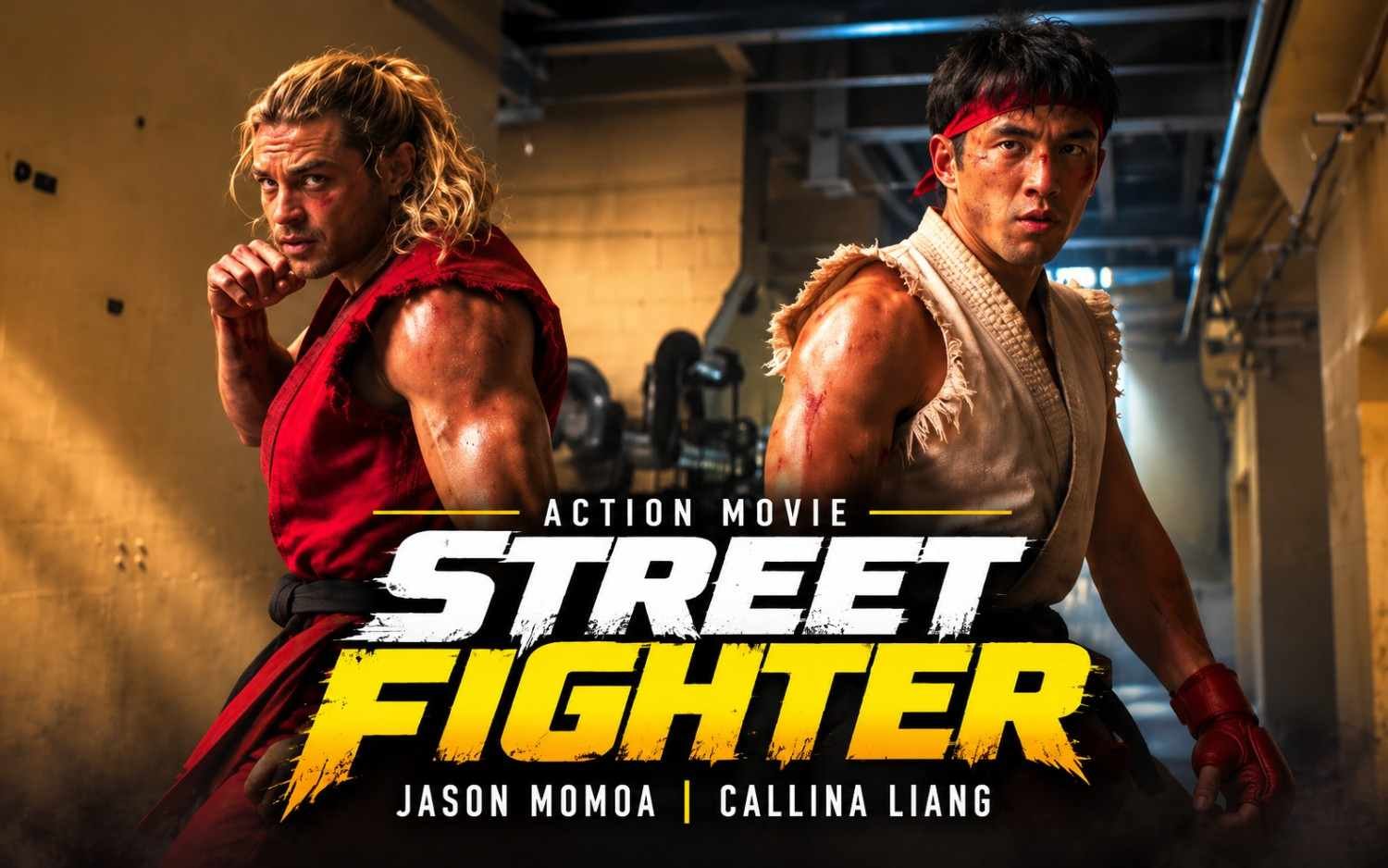
Street Fighter – Action Movie | Jason Momoa | Callina Liang
Movie Details
| Movie Details | Information |
|---|---|
| Movie Name | Street Fighter |
| Director | Kitao Sakurai |
| Based On | Capcom’s Street Fighter video-game franchise |
| Lead Cast | Jason Momoa, Callina Liang, Andrew Koji, Noah Centineo, Roman Reigns, Orville Peck |
| Supporting Cast | David Dastmalchian, Cody Rhodes, Andrew Schulz, Mel Jarnson, Hirooki Goto, Ray Nicholson, Eric André |
| Genre | Action, Martial Arts, Adventure, Fantasy |
| Language | English |
| Release Date | October 16, 2026 |
| Theatrical Release | Legendary Entertainment / Paramount Pictures |
| Source Material | Capcom’s Street Fighter video-game series |
| Rating | 3.5/5 Stars |
Street Fighter – Action Movie | Jason Momoa | Callina Liang
Introduction & Overview
Street Fighter is one of the most anticipated video-game adaptations currently heading to the big screen. Based on Capcom’s legendary fighting-game franchise, the new action movie attempts to translate the colorful characters, martial-arts mythology and competitive spirit of the games into a large-scale cinematic experience.
The film is directed by Kitao Sakurai and features a striking ensemble led by Jason Momoa, Callina Liang, Andrew Koji, Noah Centineo, Roman Reigns and Orville Peck. The supporting cast is equally intriguing, with names including David Dastmalchian, Cody Rhodes, Andrew Schulz, Hirooki Goto, Ray Nicholson and Eric André.
What immediately separates the project from an ordinary action movie is its source material. Street Fighter has spent decades establishing recognizable warriors, signature moves and rivalries that are already familiar to millions of players around the world.
The challenge is therefore enormous: the film must satisfy longtime fans while remaining accessible to viewers who may never have played the games.
From its casting choices to its martial-arts focus, Street Fighter appears determined to embrace the larger-than-life identity of the franchise rather than turning it into a generic Hollywood action film.
Detailed Plot Summary
The story centers on Ryu, one of the most recognizable characters in the Street Fighter universe, whose journey is tied to the pursuit of strength, discipline and self-understanding.
Ryu’s path brings him into contact with a series of fighters whose motivations range from personal ambition to revenge and the desire for ultimate power. Among the most important figures is Ken Masters, Ryu’s longtime friend and rival.
The relationship between Ryu and Ken has always been central to the Street Fighter mythology. They represent two different approaches to martial arts while sharing a deep connection forged through years of training and competition.
The movie expands that rivalry into a broader conflict involving some of the franchise’s most recognizable personalities.
Chun-Li, a highly skilled fighter and investigator, becomes an important figure within the story. Her determination and combat abilities make her one of the characters capable of challenging powerful opponents while also pursuing her own objectives.
The narrative also introduces Akuma, a formidable warrior associated with the darker and more dangerous side of martial-arts mastery. His presence raises the stakes because he represents an extreme version of the pursuit of power.
The film’s storyline brings these characters into a world where competitive fighting is not simply sport. Personal history, rivalries and hidden motivations transform battles into matters of survival and identity.
Ryu’s journey is therefore both physical and psychological. His opponents force him to question what it means to become stronger and whether victory is actually the ultimate goal of martial-arts training.
The story is expected to balance individual character arcs with large-scale action sequences. Tournament-style confrontations, one-on-one battles and rivalries provide the framework for the movie, while the characters’ personal motivations give those fights emotional significance.
Without revealing the major twists or final confrontation, the narrative ultimately revolves around strength, rivalry, discipline and the consequences of pursuing power without limits.
For longtime fans, the attraction will come from seeing familiar Street Fighter mythology translated into live-action. For newcomers, the movie functions as a martial-arts adventure featuring a collection of distinctive fighters with different styles and personalities.
Cast Performances & Character Breakdown
Jason Momoa
Jason Momoa is one of the movie’s biggest casting attractions. Known for his commanding physical presence, Momoa brings the kind of larger-than-life energy that fits naturally into the exaggerated world of Street Fighter.
His role adds considerable star power to the project, particularly because the franchise requires performers who can make stylized action feel believable.
Momoa’s strength as a performer is his ability to combine physical intensity with humor and charisma. Those qualities could be especially valuable in a movie where action and personality need to coexist.
Rather than simply relying on martial-arts choreography, the character benefits from Momoa’s ability to dominate the screen.
Callina Liang
Callina Liang is another major component of the cast and brings a different energy to the film.
Her presence is important because Street Fighter requires its female characters to be convincing as elite fighters rather than merely supporting figures.
Liang’s role provides the opportunity for the movie to balance physical action with character-driven moments. Her performance will be particularly important in scenes where emotional stakes intersect with combat.
Andrew Koji
Andrew Koji brings significant martial-arts credibility to the ensemble.
His previous experience with physically demanding action makes him a natural fit for a franchise where choreography is central to the storytelling.
Koji’s presence should help give the film’s fight sequences a greater sense of authenticity, particularly when characters engage in close-range combat.
Noah Centineo
Noah Centineo adds youthful energy to the ensemble.
His inclusion gives the film another recognizable contemporary actor capable of bringing humor and personality to an otherwise action-heavy narrative.
The contrast between Centineo’s style and the more physically imposing performers could create interesting character dynamics.
Roman Reigns
Professional wrestling star Roman Reigns is another major attraction.
Reigns possesses an imposing physical presence that translates naturally to the world of larger-than-life combat. His casting also creates an intriguing bridge between professional wrestling audiences and video-game fans.
His involvement should make his action sequences particularly memorable.
Orville Peck
Orville Peck brings an unconventional presence to the cast.
His inclusion reflects the movie’s willingness to embrace unusual casting choices rather than assembling a conventional action ensemble.
That unpredictability could become one of Street Fighter’s most entertaining qualities.
David Dastmalchian
David Dastmalchian adds considerable character-acting experience to the ensemble.
His ability to play unusual and eccentric personalities makes him particularly well suited to a universe where characters are often exaggerated without necessarily becoming one-dimensional.
Cody Rhodes
Cody Rhodes is another professional-wrestling personality appearing in the film.
His background in wrestling provides obvious advantages for an action movie built around combat and spectacle.
Supporting Ensemble
The wider cast includes Andrew Schulz, Mel Jarnson, Hirooki Goto, Ray Nicholson and Eric André.
Each performer contributes to a colorful ensemble that reflects the variety of the Street Fighter universe. With professional wrestlers, martial artists, dramatic actors and comedians represented, the movie has a deliberately unconventional casting profile.
That mixture could become one of the film’s greatest strengths because the Street Fighter franchise itself has always been defined by characters with wildly different personalities, fighting styles and visual identities.
Direction, Screenplay & Technical Aspects
Kitao Sakurai directs Street Fighter with the difficult responsibility of translating an arcade fighting game into a feature-length narrative.
The biggest challenge is making combat meaningful beyond visual spectacle. Video-game battles can continue indefinitely because the player controls the action, whereas a movie needs narrative reasons for every confrontation.
The screenplay therefore has to establish motivations and relationships that make the fights matter.
The film’s visual identity is expected to be one of its defining characteristics. Street Fighter has an unmistakable aesthetic, with colorful costumes, distinctive fighters and recognizable combat techniques.
Translating those elements into live action requires careful production design and choreography. The movie cannot simply reproduce the exaggerated visuals of a game without adaptation, but it also cannot remove the personality that makes the franchise unique.
Fight choreography will naturally be one of the most important technical components. Each major character has a recognizable fighting style, meaning that combat should ideally communicate personality as well as physical skill.
Cinematography also plays a crucial role. Close-up shots can emphasize impact and technique, while wider compositions can showcase larger battles.
Editing must maintain a clear sense of geography during fights. If audiences cannot understand where characters are positioned, even excellent choreography can lose its impact.
The sound design and background score should complement the physicality of the battles, particularly during major confrontations.
Ultimately, the technical success of Street Fighter will depend on whether the film can make its action feel both spectacular and emotionally meaningful.
Strengths & Weaknesses / Pros & Cons
Pros
- Iconic source material: Street Fighter has decades of established characters and mythology behind it.
- Strong action potential: The franchise naturally lends itself to elaborate martial-arts choreography.
- Jason Momoa’s screen presence: His charisma and physicality are ideal for a larger-than-life action movie.
- Interesting ensemble: The combination of actors, martial artists and professional wrestlers makes the casting unusually distinctive.
- Recognizable characters: Ryu, Ken, Chun-Li and other franchise favorites provide immediate audience familiarity.
- Cross-generational appeal: The movie can potentially attract longtime gamers as well as younger action audiences.
Cons
- High expectations: Fans have strong opinions about how iconic characters should be represented.
- Video-game adaptation challenges: Translating gameplay mechanics into a coherent movie narrative is difficult.
- Risk of excessive spectacle: Too much emphasis on action could reduce character development.
- Large ensemble: Giving every major character enough screen time could be challenging.
- Balancing tone: The movie needs to retain the colorful personality of the games without becoming unintentionally campy.
Final Verdict & Target Audience
Street Fighter has the ingredients to become an entertaining new chapter in the long history of video-game adaptations. The combination of Jason Momoa, Callina Liang, Andrew Koji, Noah Centineo and Roman Reigns, alongside a highly recognizable roster of characters, gives the film substantial commercial appeal.
The movie is particularly suited to action fans, martial-arts enthusiasts, gamers and longtime Street Fighter followers.
Its success will ultimately depend on the balance between faithful fan service and accessible storytelling. If the action delivers while the characters receive enough emotional depth, Street Fighter could become one of the more memorable video-game adaptations.
For fans of the franchise, this is undoubtedly a theatrical experience worth watching for the scale, fights and recognizable characters.
Final Rating: 3.5/5 Stars