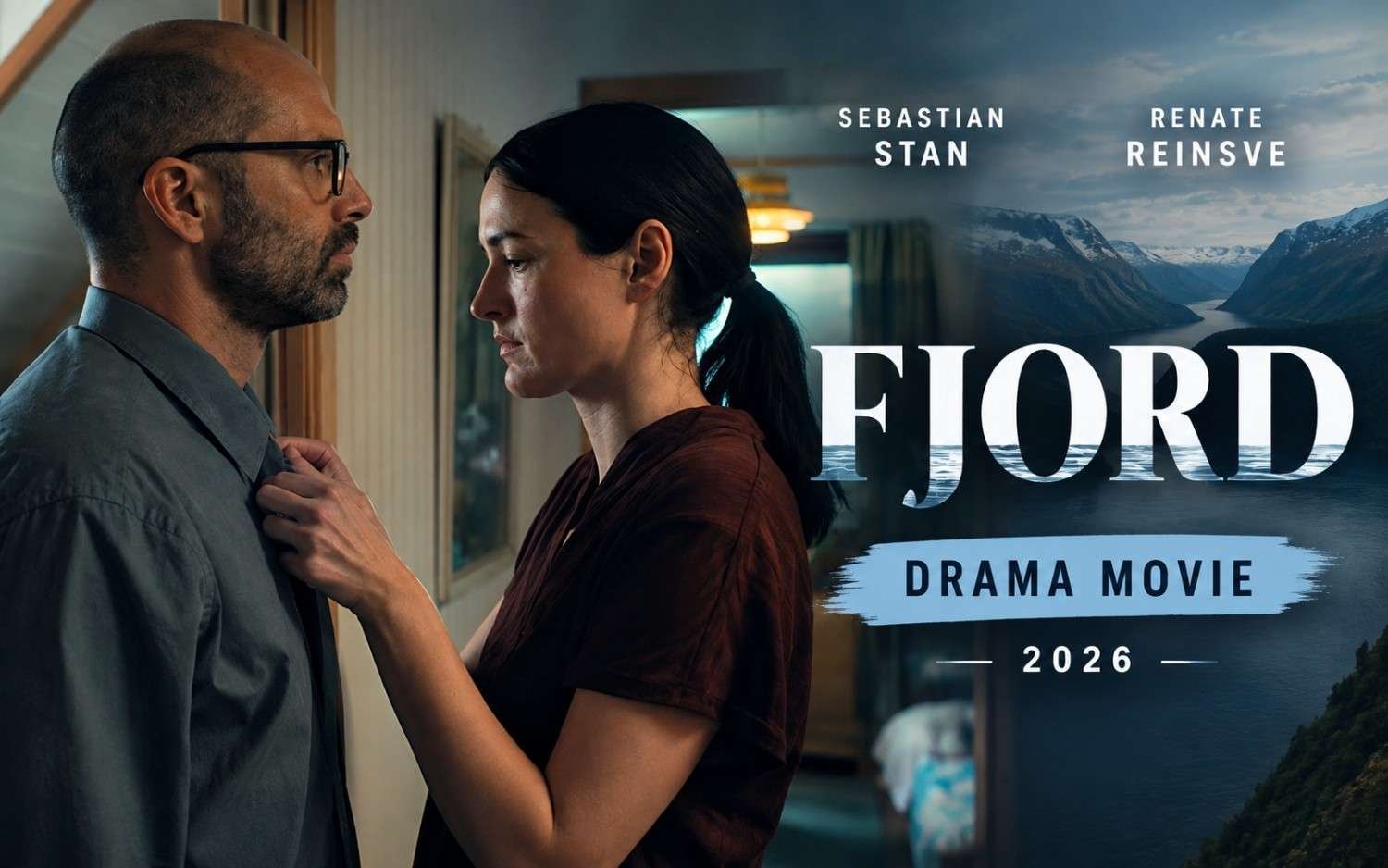
Fjord (2026) Drama Movie | Sebastian Stan | Renate Reinsve
Movie Details
| Movie Details | Information |
|---|---|
| Movie Name | Fjord |
| Director & Writer | Cristian Mungiu |
| Lead Cast | Sebastian Stan, Renate Reinsve |
| Supporting Cast | Lisa Carlehed, Ellen Dorrit Petersen, Lisa Loven Kongsli, Henrikke Lund-Olsen, Vanessa Ceban, Thorbjørn Harr, Christian Rubeck, Ingvild Lien, Giulia Nahmany, Hallgjerd Byrkjeland, Sofie Vartdal, Nanna Bengtson, Peter Drabløs, Ana Bodea, Øyvind Venstad Kjeksrud |
| Characters | Mihai Gheorghiu, Lisbet Gheorghiu, Mia, Gunda, Frida, Noora, Elia and others |
| Genre | Drama, Family Drama, Legal Drama, Thriller |
| Runtime | 146 Minutes |
| Languages | Romanian, Norwegian, English |
| Release Date | October 9, 2026 |
| OTT Platform | No streaming platform announced yet |
| Rating | 4/5 Stars |
Fjord (2026) Drama Movie | Sebastian Stan | Renate Reinsve
Introduction & Overview
Fjord (2026) is a serious and thought-provoking drama from acclaimed Romanian filmmaker Cristian Mungiu, featuring Sebastian Stan and Renate Reinsve in the central roles. Set against the breathtaking but emotionally cold landscape of a remote Norwegian fjord, the film explores family, faith, parenting, cultural differences and the difficult boundaries between private life and institutional intervention.
The story follows a Romanian-Norwegian couple who relocate with their children to the mother’s remote Norwegian hometown. What begins as an attempt to reconnect with family and build a new life gradually turns into an unsettling confrontation with the surrounding community and the Norwegian child-protection system.
Rather than relying on conventional thriller mechanics, Fjord creates tension through uncertainty. The audience is repeatedly encouraged to question what constitutes responsible parenting, where cultural difference ends and potential harm begins, and whether institutions can make completely objective judgments about a family.
The film also represents another major collaboration between Mungiu and the international film world. Its combination of an intimate family story, social commentary and a restrained visual style makes Fjord considerably more than a conventional domestic drama.
Detailed Plot Summary
At the centre of Fjord are Mihai Gheorghiu, played by Sebastian Stan, and Lisbet Gheorghiu, played by Renate Reinsve. The couple have Romanian and Norwegian backgrounds and relocate with their children to Lisbet’s birthplace, a remote community situated around a dramatic Norwegian fjord. The family is deeply religious and follows a conservative approach to family life and child-rearing.
The move initially offers the promise of a fresh beginning. Mihai and Lisbet are reunited with a landscape and community connected to Lisbet’s past, while their children begin forming relationships with children from a neighbouring family. The surrounding environment is beautiful, quiet and isolated, creating the impression that the family has escaped the pressures of their previous life.
However, that sense of security does not last.
The situation changes when their adolescent daughter Elia arrives at school with bruises. What could initially be interpreted as an ordinary family incident becomes a matter of concern within the community. Questions begin to emerge about how the Gheorghius raise their children and whether their strict and traditional approach could have contributed to what happened.
As concern develops into formal scrutiny, the family’s private life increasingly becomes the subject of outside examination. Their religious beliefs, parenting methods and relationship with their children are examined by people who do not necessarily share their worldview.
This is where Fjord becomes more complex than a simple family drama. The conflict is not presented as an uncomplicated battle between obviously good and bad characters. Instead, the film creates an atmosphere in which different interpretations of the same events become possible.
Mihai and Lisbet must defend their family while navigating a system that has its own responsibilities and procedures. Meanwhile, the community’s reaction introduces another layer of pressure. Personal relationships become entangled with institutional judgment, and the family’s attempt to maintain control over its private life becomes increasingly difficult.
The film deliberately avoids turning its central conflict into an easy mystery with an obvious answer. Instead, it asks viewers to observe the evidence, motivations and competing perspectives before reaching their own conclusions. That ambiguity is a major part of its dramatic power.
Cast Performances & Character Breakdown
Sebastian Stan as Mihai Gheorghiu
Sebastian Stan takes on the role of Mihai Gheorghiu, a Romanian father whose family becomes the focus of increasing scrutiny. The role is significantly different from many of Stan’s more recognizable mainstream performances.
Mihai is presented as restrained and internally pressured rather than openly theatrical. His emotions frequently remain beneath the surface, making small changes in expression and body language particularly important. The character is attempting to protect his family while simultaneously dealing with a community and institutional system that he feels may not understand his beliefs.
Stan’s performance benefits from this restraint. Instead of explaining Mihai’s emotional state through long speeches, the character’s frustration and fear emerge gradually. His performance becomes especially effective because the film allows the audience to sit with his uncertainty rather than immediately telling us how to interpret him.
The multilingual nature of the role also adds another dimension. Fjord uses Romanian, Norwegian and English, giving Stan an opportunity to portray a character negotiating multiple cultural environments.
Renate Reinsve as Lisbet Gheorghiu
Renate Reinsve plays Lisbet, Mihai’s Norwegian wife and the connection between the family and the remote community they move into.
Lisbet’s position is particularly complicated because the village is connected to her own background. She is not simply an outsider arriving in an unfamiliar country. Instead, she returns to a place that should, theoretically, feel like home.
Reinsve brings considerable subtlety to the character. Lisbet must balance her relationship with Mihai, her responsibilities as a mother and her connection to the surrounding community. As pressure increases, those different relationships begin pulling her in opposing directions.
Her performance works through emotional restraint rather than melodrama, making Lisbet’s changing circumstances feel personal and believable.
Lisa Carlehed as Mia
Lisa Carlehed plays Mia, a supporting character who becomes part of the wider social environment surrounding the Gheorghiu family.
The supporting roles in Fjord are important because the story is not simply about one family in isolation. Characters such as Mia help represent the network of relationships and social perspectives surrounding the central conflict.
Ellen Dorrit Petersen as Gunda
Ellen Dorrit Petersen plays Gunda, another important figure within the story’s institutional and community framework.
Her presence contributes to the film’s exploration of how families are perceived by people outside their immediate household. The supporting performances avoid turning the conflict into a simple collection of heroes and villains.
Lisa Loven Kongsli as Frida
Lisa Loven Kongsli appears as Frida, adding another perspective to the community surrounding the central family.
Her role helps strengthen the film’s social dimension, showing that the conflict affects relationships beyond the immediate parent-child dynamic.
Henrikke Lund-Olsen and Vanessa Ceban
Henrikke Lund-Olsen and Vanessa Ceban are also part of the cast, with Vanessa Ceban portraying Elia, the teenage daughter whose bruises become the catalyst for the film’s central conflict.
Elia’s role is crucial because the entire chain of events begins with concern over her wellbeing. Her presence keeps the story grounded in the children whose lives are affected by decisions made by adults and institutions.
Other Supporting Performers
The ensemble also includes Thorbjørn Harr, Christian Rubeck, Ingvild Lien, Giulia Nahmany, Hallgjerd Byrkjeland, Sofie Vartdal, Nanna Bengtson, Peter Drabløs, Ana Bodea and Øyvind Venstad Kjeksrud, among others.
Together, the supporting cast creates a believable social and institutional environment around the Gheorghiu family. Their importance lies not merely in individual screen time but in making the community feel like an active force within the narrative.
Direction, Screenplay & Technical Aspects
Cristian Mungiu writes and directs Fjord, and his approach is central to the movie’s distinctive tone. Rather than forcing the story into a conventional thriller structure, Mungiu allows tension to develop gradually through conversations, observation and increasingly uncomfortable social interactions.
The screenplay is particularly effective in leaving room for ambiguity. The film’s central issue cannot be reduced to a simple argument between traditional and progressive values. Instead, Mungiu examines how both personal beliefs and institutional assumptions can influence the way a family is judged.
Tudor Vladimir Panduru handles cinematography, creating a visual contrast between the breathtaking Norwegian landscape and the increasingly tense domestic situation. The fjord environment provides enormous natural beauty, but that beauty is often accompanied by a feeling of isolation.
Mircea Olteanu serves as editor, and the film’s lengthy 146-minute runtime allows the story to develop patiently. Rather than rushing from one dramatic event to another, the editing supports the film’s observational character.
Kaspar Kaae provides the music, while the sound team contributes to the film’s restrained atmosphere. The technical design generally avoids excessive melodrama, allowing silence, natural surroundings and measured performances to carry much of the emotional weight.
The result is a film where the landscape becomes almost another character. The enormous fjord and isolated village provide an appropriately enclosed environment for a story about family privacy, public judgment and institutional scrutiny.
Strengths & Weaknesses / Pros & Cons
Strengths
- Powerful central performances: Sebastian Stan and Renate Reinsve deliver restrained performances that suit the film’s morally complex material.
- Strong direction: Cristian Mungiu maintains a patient, observational approach rather than simplifying the central conflict.
- Atmospheric cinematography: The Norwegian landscapes provide both beauty and a sense of isolation.
- Complex subject matter: The film explores parenting, faith, cultural differences and institutional intervention without reducing them to simple answers.
- Excellent supporting ensemble: The large supporting cast gives the community and institutional world credibility.
- Thought-provoking screenplay: The story encourages viewers to question their own assumptions rather than dictating a single interpretation.
Weaknesses
- Slow pacing: At 146 minutes, the film demands patience and may feel deliberately slow to viewers accustomed to faster thrillers.
- Emotional distance: The restrained storytelling can make some scenes feel less immediately accessible.
- Heavy subject matter: Its focus on family scrutiny and child-protection proceedings makes it an intense viewing experience.
- Ambiguous storytelling: Viewers looking for definitive answers may find the film’s refusal to simplify its conflict challenging.
Final Verdict & Target Audience
Fjord (2026) is a serious, atmospheric family drama that uses one family’s experience to examine much larger questions about parenting, religion, cultural identity, community judgment and institutional power. Sebastian Stan and Renate Reinsve provide the emotional centre, while Cristian Mungiu’s direction keeps the story deliberately complex and morally uncertain.
The film is best suited to audiences who appreciate slow-burn dramas, European cinema, psychological family stories and socially challenging narratives. It is particularly appropriate for viewers who enjoy films that continue to provoke discussion after the credits.
For audiences seeking a fast commercial thriller, the deliberate pace may require patience. For viewers interested in character-driven cinema and morally complicated storytelling, Fjord offers a substantial theatrical experience. The film is scheduled for theatrical release on October 9, 2026, with no streaming platform announced at present.
Final Rating: 4/5 Stars