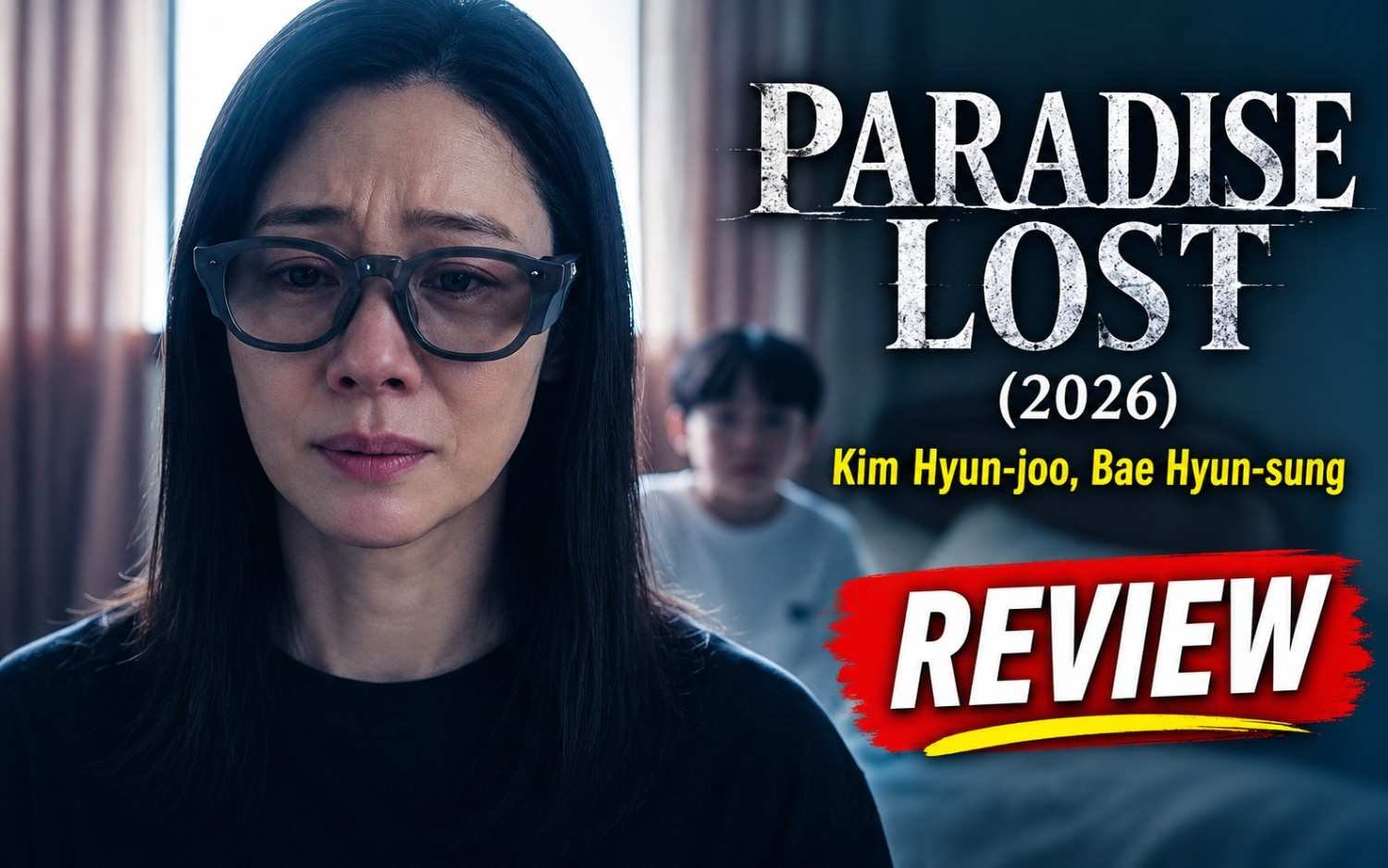
Paradise Lost (2026) is a South Korean psychological mystery thriller that explores the emotional consequences of loss, the complexity of family relationships, and the growing influence of artificial intelligence in human life. Directed by acclaimed filmmaker Yeon Sang-ho, the movie brings together an intriguing storyline, unsettling suspense, and a talented Korean cast led by Kim Hyun-joo and Bae Hyun-sung.
Rather than relying entirely on conventional thriller elements, Paradise Lost builds its central mystery around a mother’s emotional struggle after her missing son unexpectedly returns home nine years after disappearing. What should have been a joyful reunion gradually becomes an uncomfortable and frightening experience as the mother discovers that the child she remembers and the young man standing before her are no longer the same.
With its combination of psychological drama, science fiction, mystery, and emotional storytelling, Paradise Lost presents an unusual cinematic experience. The film also raises thought-provoking questions about artificial intelligence, memory, identity, grief, and the difference between a virtual recreation and a real human relationship.
In this Paradise Lost movie review, we explore the storyline, cast performances, direction, trailer, major themes, cinematic appeal, and everything audiences should know about this Korean thriller.
Paradise Lost (2026) Movie Details
| Category | Details |
|---|---|
| Movie Name | Paradise Lost |
| Release Year | 2026 |
| Original Language | Korean |
| Country | South Korea |
| Genre | Psychological Thriller, Mystery, Science Fiction, Drama |
| Director | Yeon Sang-ho |
| Writers | Yeon Sang-ho, Ryu Yong-jae |
| Lead Cast | Kim Hyun-joo, Bae Hyun-sung |
| Supporting Cast | Lee Hyun-kyun, Kim Jong-tae and others |
| Production Company | Wow Point |
| Runtime | Approximately 101 minutes |
| South Korean Release | October 21, 2026 |
| US Theatrical Release | November 6, 2026 |
Paradise Lost Story: A Mysterious Reunion After Nine Years
The storyline of Paradise Lost begins with a heartbreaking incident involving a school camping trip. A school bus carrying several children suddenly disappears, leaving their families facing uncertainty, grief, and unanswered questions.
Among the missing children is Ryu Sun-woo, the beloved son of Ryu So-young, played by Kim Hyun-joo. Following the disappearance, So-young is left struggling to accept the possibility that she may never see her child again.
Nine years pass, but the emotional wounds remain. For So-young, the absence of her son becomes an unavoidable part of everyday life. She continues living with the memories of the child she once knew, unable to completely move forward from the tragedy.
During this difficult period, she finds emotional comfort through an artificial intelligence program called Children of Paradise. The technology allows her to interact with a virtual recreation of her son as he appeared during childhood.
The AI-generated version provides a form of companionship that helps So-young manage her grief. Although she understands that the virtual child is not physically real, the experience offers her an opportunity to maintain an emotional connection with the son she lost.
Everything changes when Sun-woo unexpectedly returns home after nine years.
Instead of bringing the happiness So-young imagined, his return creates a new emotional crisis. Sun-woo is now an adult, and his appearance, personality, and behaviour are dramatically different from the innocent child preserved in his mother’s memories.
His body carries visible scars, and his expressions seem distant and difficult to understand. So-young struggles to recognise the person standing before her.
The situation becomes increasingly complicated because she must now live with two versions of her son: the real adult Sun-woo and the artificial intelligence recreation of his younger self.
This unusual situation forms the central mystery of Paradise Lost.
As the story develops, the uncomfortable reunion exposes deeper questions about Sun-woo’s disappearance, his experiences during those nine years, and the disturbing truth behind his unexpected return.
Kim Hyun-joo as Ryu So-young: An Emotional Performance
Kim Hyun-joo takes the lead role as Ryu So-young, a mother whose life has been shaped by the disappearance of her son.
Her character is emotionally complex because she experiences several conflicting feelings throughout the story. She desperately wants her child back, but when he finally returns, she discovers that she cannot easily reconnect with him.
The character’s psychological struggle provides the emotional foundation of the movie.
So-young has spent nine years preserving the memory of her son through an AI-generated childhood recreation. Consequently, the arrival of the real Sun-woo challenges the emotional reality she has constructed.
Kim Hyun-joo’s casting is particularly interesting because she previously collaborated with director Yeon Sang-ho on the popular Korean series Hellbound.
In Paradise Lost, her character requires a different emotional approach, balancing maternal affection, fear, guilt, uncertainty, and psychological distress.
Her performance is central to the film’s ability to communicate the emotional consequences of losing a loved one and struggling to accept their changed identity.
Bae Hyun-sung as Ryu Sun-woo: The Son Who Returns
Bae Hyun-sung plays Ryu Sun-woo, the missing child who unexpectedly returns home as a young adult after nine years.
His character is one of the most mysterious elements of the film.
Sun-woo is not the innocent child his mother remembers. His physical appearance and unsettling behaviour suggest that his experiences during the years of disappearance have profoundly changed him.
The difference between the childhood version preserved by artificial intelligence and the real adult Sun-woo creates an interesting psychological conflict.
Bae Hyun-sung must portray a character whose presence raises more questions than answers.
His performance is important because the audience gradually discovers the story through the reactions of the people around him. His relationship with So-young becomes the emotional centre of the mystery.
The character also raises an important question: Can a family relationship return to normal after years of separation when the people involved have changed completely?
Lee Hyun-kyun, Kim Jong-tae and Yoon Hyun-gil: Supporting Cast
Apart from its lead performers, Paradise Lost features a supporting ensemble that contributes to the film’s broader dramatic and mysterious atmosphere.
Lee Hyun-kyun and Kim Jong-tae are among the supporting performers associated with the project. Their presence adds further depth to the film’s character-driven narrative.
Yoon Hyun-gil is also included in the film’s featured cast information.
While Kim Hyun-joo and Bae Hyun-sung remain the central performers, the supporting characters help establish the wider circumstances surrounding the disappearance and return.
The mystery requires more than a simple mother-and-son relationship. The surrounding characters and events contribute to the gradual development of the story.
Yeon Sang-ho’s Direction: A Different Kind of Korean Thriller
One of the biggest attractions of Paradise Lost is its director, Yeon Sang-ho.
He is internationally recognised for directing Train to Busan, a successful South Korean zombie thriller that received considerable attention from audiences around the world.
His other notable projects include Peninsula, The King of Pigs, Hellbound, and The Face.
Yeon Sang-ho has demonstrated an interest in combining genre entertainment with social commentary and emotionally complicated characters.
Paradise Lost continues that creative approach through its exploration of artificial intelligence and human relationships.
Instead of presenting AI simply as a technological invention, the movie examines how people might use technology to manage emotional pain.
The film’s central idea is particularly relevant in a world where artificial intelligence can recreate voices, images, personalities, and digital representations of people.
The director uses this concept to develop a psychological mystery about the boundaries between reality and artificial companionship.
The result is a story that combines personal tragedy with broader questions about modern technology.
Artificial Intelligence and the Emotional Core of Paradise Lost
One of the most distinctive aspects of Paradise Lost is its use of artificial intelligence as an important storytelling element.
The Children of Paradise program allows So-young to interact with a digital recreation of her missing son.
For someone experiencing profound grief, such technology may appear comforting. It creates an opportunity to revisit familiar memories and maintain a connection with someone who is no longer physically present.
However, the arrival of the real Sun-woo changes the meaning of that experience.
The artificial version remains frozen in childhood, responding within the limitations of its programmed identity. The real person, meanwhile, has experienced nine years of life that his mother cannot fully understand.
This contrast raises several interesting questions.
Can an artificial intelligence program truly replace a human relationship? Is a digital recreation capable of understanding emotional pain? Can memories become more powerful than reality when someone refuses to accept change?
Paradise Lost uses these questions to create an unsettling psychological atmosphere.
The film’s approach to AI is especially relevant because modern technology increasingly allows people to interact with digital versions of individuals.
Rather than treating this development as an entirely positive or negative phenomenon, the story explores its emotional complications.
Paradise Lost Trailer: What Does It Reveal?
The Paradise Lost trailer introduces the film’s central mystery and establishes its dark psychological atmosphere.
The promotional footage focuses on the reunion between So-young and her missing son. Initially, the return of Sun-woo appears to be an extraordinary moment of happiness.
However, the atmosphere quickly changes as his mother begins noticing differences between the person she remembers and the young man who has returned.
The trailer highlights the emotional distance between the two characters and suggests that Sun-woo’s disappearance involved circumstances far more complicated than a simple separation.
The AI recreation of the childhood version of Sun-woo adds another unusual dimension to the promotional footage.
It creates a visual and emotional contrast between the familiar digital child and the mysterious adult who has suddenly entered So-young’s life.
The trailer effectively introduces the central question surrounding the movie: What happens when the person you have spent years waiting for finally returns, but no longer feels like the person you lost?
Watch the Paradise Lost official trailer:
Watch the additional Paradise Lost video:
What Makes Paradise Lost Different from Other Korean Thriller Movies?
South Korean cinema has developed an international reputation for producing distinctive psychological thrillers, crime dramas, mysteries, and science-fiction films.
Paradise Lost stands out because its central mystery is closely connected to an emotional family relationship.
Many conventional thrillers focus on solving crimes, identifying criminals, or uncovering hidden conspiracies. Paradise Lost approaches suspense through the psychological experience of a mother who cannot understand the son who has returned.
Its major distinguishing elements include:
1. A Unique Psychological Mystery
The disappearance of a school bus and the unexpected return of a missing child provide a compelling foundation for suspense.
2. An Emotional Mother-and-Son Relationship
The story examines how prolonged separation can transform family relationships and create emotional distance.
3. Artificial Intelligence as a Storytelling Element
The digital recreation of a missing child introduces a contemporary technological dimension.
4. An Unsettling Central Character
Sun-woo’s changed appearance and mysterious behaviour make his return an important source of tension.
5. A Recognised Korean Filmmaker
Yeon Sang-ho’s experience with psychological storytelling, science fiction, and genre filmmaking adds considerable interest to the project.
Paradise Lost Release Date and International Availability
Paradise Lost is a 2026 South Korean production directed by Yeon Sang-ho.
The film premiered in the Special Presentations section of the 2026 Toronto International Film Festival before its South Korean theatrical release.
Its South Korean theatrical release took place on October 21, 2026.
The movie is also scheduled for a limited theatrical release in the United States on November 6, 2026, through Well Go USA Entertainment.
With its international festival exposure and distribution arrangements, the film has attracted attention beyond the South Korean market.
The original language is Korean, and international viewers can look for screenings featuring English subtitles.
An official worldwide OTT streaming release date and platform should be confirmed through the distributor or streaming service rather than assumed.
Paradise Lost Movie Review: Story, Performances and Overall Appeal
Paradise Lost brings together several interesting elements that make it an intriguing addition to the 2026 Korean psychological thriller lineup.
Its greatest strength is the central premise. The idea of a mother interacting with an AI recreation of her missing child before unexpectedly meeting the real adult version creates an unusual emotional conflict.
The storyline offers opportunities for suspense while exploring the complicated nature of grief, memory, and identity.
Kim Hyun-joo’s role as So-young provides the emotional foundation, while Bae Hyun-sung’s portrayal of Sun-woo introduces the mystery that drives the narrative.
Director Yeon Sang-ho also brings experience in combining genre storytelling with contemporary social themes.
The artificial intelligence concept gives the film additional relevance, particularly for audiences interested in how technology might influence human emotions and relationships.
However, viewers expecting a conventional action thriller may find that the film’s central attraction is its psychological and emotional tension.
Its appeal lies in the unsettling questions surrounding the missing child’s return rather than simply delivering a straightforward mystery.
Who Should Watch Paradise Lost?
Paradise Lost may appeal to several categories of movie enthusiasts.
- Korean cinema fans: Viewers interested in contemporary South Korean movies will find the film an interesting addition to the genre.
- Psychological thriller enthusiasts: The unusual reunion and mysterious circumstances offer an intriguing premise.
- Science-fiction audiences: The use of artificial intelligence introduces thought-provoking technological themes.
- Yeon Sang-ho fans: Followers of the director’s previous films and television projects may be interested in his latest psychological thriller.
- Kim Hyun-joo and Bae Hyun-sung fans: The lead performances provide another reason to explore the movie.
Final Verdict: Is Paradise Lost (2026) Worth Watching?
Paradise Lost is an intriguing South Korean psychological mystery thriller built around an unusual family reunion and the emotional consequences of artificial intelligence.
With Kim Hyun-joo and Bae Hyun-sung leading the cast, the film explores a mother’s struggle to reconnect with her missing son after nine years of separation.
The direction of Yeon Sang-ho adds further interest, particularly because the filmmaker combines a personal family tragedy with contemporary questions about technology, identity, and human relationships.
The movie’s central concept is its biggest attraction. A mother who has spent years communicating with an artificial version of her missing child must suddenly confront the real person, who has returned as someone she barely recognises.
For audiences who appreciate Korean mystery films, psychological thrillers, emotional dramas, and science-fiction storytelling, Paradise Lost deserves attention.
Overall, Paradise Lost (2026) is a compelling film to explore for its distinctive premise, intriguing mystery, and emotionally complex characters.
Frequently Asked Questions (FAQs)
1. What is Paradise Lost (2026) about?
Paradise Lost follows Ryu So-young, a mother whose son disappeared during a school camping trip. Nine years later, he unexpectedly returns as an adult. During his absence, she had used an artificial intelligence program to interact with a digital recreation of him as a child. His return creates an unsettling family situation.
2. Who are the lead actors in Paradise Lost?
The film stars Kim Hyun-joo as Ryu So-young and Bae Hyun-sung as Ryu Sun-woo. Other performers associated with the film include Lee Hyun-kyun and Kim Jong-tae.
3. Who directed Paradise Lost?
Paradise Lost is directed by Yeon Sang-ho, the South Korean filmmaker known for Train to Busan, Peninsula, and Hellbound.
4. When was Paradise Lost released?
The movie was released theatrically in South Korea on October 21, 2026. Its limited US theatrical release is scheduled for November 6, 2026.
5. What is the genre of Paradise Lost?
Paradise Lost combines psychological thriller, mystery, science fiction, and drama elements.
6. Is Paradise Lost a Korean movie?
Yes. Paradise Lost is a South Korean film originally produced in the Korean language.
7. What is the runtime of Paradise Lost?
The film has an approximate runtime of 101 minutes.
8. Does Paradise Lost explore artificial intelligence?
Yes. Artificial intelligence is central to the storyline. The mother uses a program called Children of Paradise to interact with a virtual recreation of her missing son.
9. Where can audiences watch the Paradise Lost trailer?
Audiences can watch the promotional videos through the YouTube links provided in this article.
10. Is Paradise Lost worth watching?
Viewers interested in Korean psychological thrillers, mysterious family stories, artificial intelligence, and emotionally driven science-fiction films may find Paradise Lost worth watching.
Final Thoughts
Paradise Lost (2026) brings an unusual combination of family drama, psychological suspense, and artificial intelligence to South Korean cinema. With Yeon Sang-ho directing and Kim Hyun-joo and Bae Hyun-sung in the leading roles, the movie offers an interesting exploration of what happens when memories, technology, and reality collide.