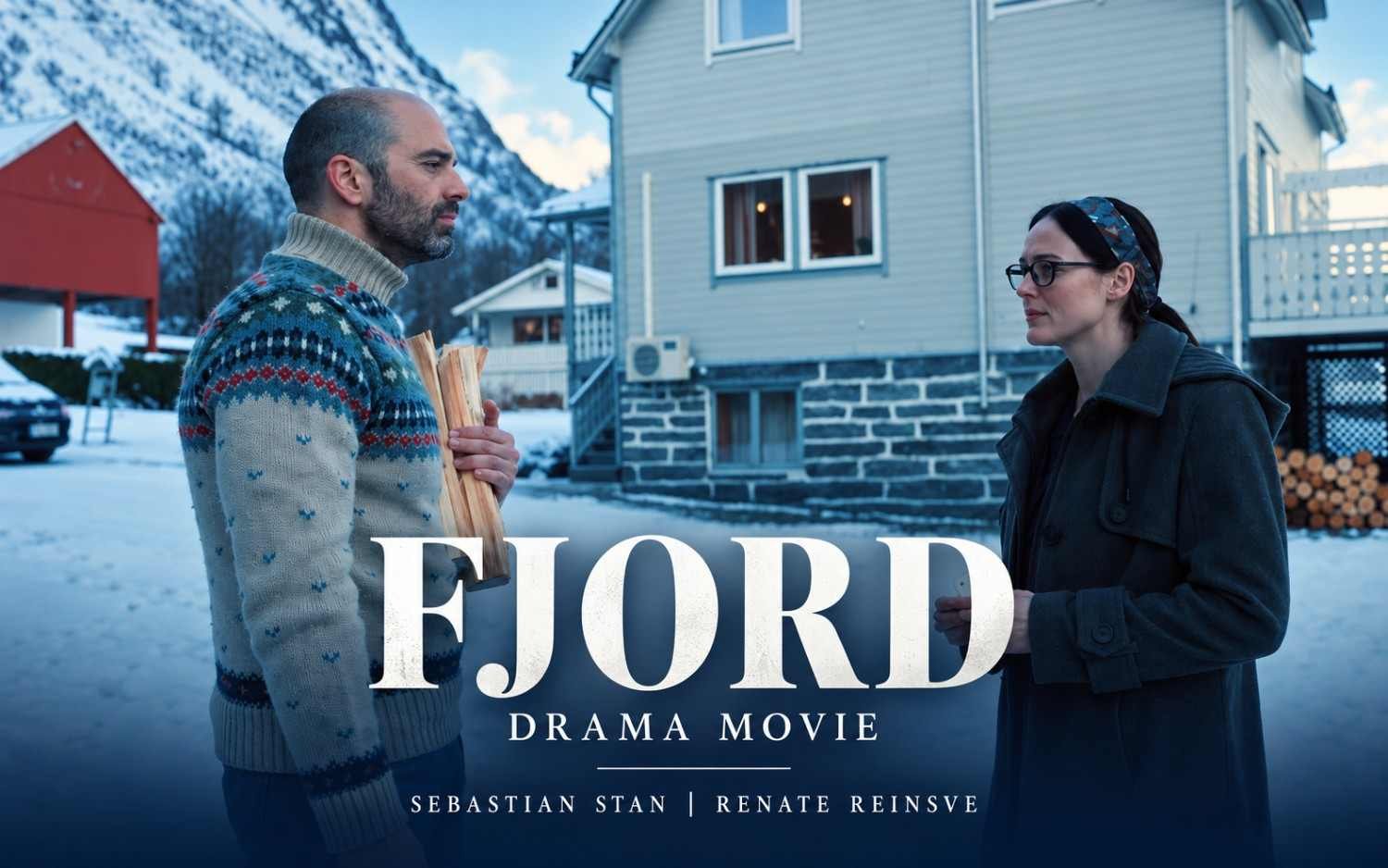
Fjord – Drama Movie | Sebastian Stan | Renate Reinsve
Movie Details
| Category | Details |
|---|---|
| Movie Name | Fjord |
| Director | Cristian Mungiu |
| Writer | Cristian Mungiu |
| Lead Cast | Sebastian Stan, Renate Reinsve |
| Supporting Cast | Lisa Carlehed, Ellen Dorrit Petersen, Lisa Loven Kongsli, Henrikke Lund-Olsen, Vanessa Ceban, Thorbjørn Harr, Christian Rubeck, Ingvild Lien, Giulia Nahmany |
| Genre | Drama / Legal Thriller / Social Drama |
| Runtime | 146 minutes |
| Languages | Romanian, Norwegian, English |
| World Premiere | May 18, 2026 – Cannes Film Festival |
| Theatrical Release | October 9, 2026 |
| OTT Platform | Not officially announced |
| Major Award | Palme d’Or – 2026 Cannes Film Festival |
| Music | Kaspar Kaae |
| Cinematography | Tudor Vladimir Panduru |
| Editing | Mircea Olteanu |
| Rating | 4.5/5 Stars |
*The film’s official and festival listings confirm Cristian Mungiu as director and screenwriter, Tudor Vladimir Panduru as cinematographer, Mircea Olteanu as editor, Kaspar Kaae as composer, and a 146-minute runtime. It won the 2026 Cannes Palme d’Or. *
Fjord – Drama Movie | Sebastian Stan | Renate Reinsve
Introduction & Overview
Fjord is a serious, intellectually challenging 2026 drama that places Sebastian Stan and Renate Reinsve at the centre of a tense story about family, faith, cultural identity and the limits of institutional authority. Directed by acclaimed Romanian filmmaker Cristian Mungiu, the film takes place in a remote Norwegian community where a Romanian-Norwegian family attempts to build a new life.
What initially appears to be a quiet family drama gradually develops into a morally complicated confrontation between parents, neighbours, social institutions and the child-protection system. The film does not offer an easy division between heroes and villains. Instead, it asks uncomfortable questions about parenting, religious conviction, cultural difference, prejudice and the responsibility of authorities to protect children.
The film became one of the major titles of the 2026 festival season after winning the Palme d’Or at Cannes, giving Fjord considerable international attention before its theatrical release.
Mungiu’s restrained filmmaking style makes the movie feel less like a conventional thriller and more like an escalating social drama in which ordinary conversations acquire extraordinary consequences.
Detailed Plot Summary
The story follows Mihai Gheorghiu, played by Sebastian Stan, and his wife Lisbet Gheorghiu, played by Renate Reinsve. The couple are Romanian-Norwegian Christians who move with their five children to a remote coastal village in Norway. Lisbet has a connection to the area, and the family’s relocation is presented as an attempt to establish a new beginning while remaining close to family and a familiar religious environment.
The Gheorghius quickly become connected to their neighbours, the Halbergs. Their children also develop friendships with children from the neighbouring family. At first, the differences between the households seem manageable. The children find common ground even though their parents have very different approaches to religion, education and family life.
The peaceful atmosphere changes when Elia Gheorghiu, the family’s teenage daughter, arrives at school with visible bruises. Concern quickly develops among people around the family, and questions begin to emerge about how the Gheorghius discipline their children.
The issue becomes increasingly serious when Norwegian authorities become involved. What begins as concern about a child’s welfare develops into an investigation that places the entire family under scrutiny. The parents must suddenly defend their beliefs, their parenting methods and their understanding of family life.
This is where Fjord becomes considerably more complex than a conventional child-protection story. The film deliberately places two different worldviews against each other. Mihai and Lisbet see their religious and traditional approach as part of their responsibility as parents, while the surrounding Norwegian institutions operate according to a different understanding of children’s rights and acceptable discipline.
The resulting conflict is not presented as a simple battle between good and evil. The authorities have legitimate concerns, but the family’s cultural and religious background also complicates the interpretation of their behaviour. The situation becomes increasingly difficult as legal procedures and social judgment begin affecting every member of the household.
The film draws inspiration from the real-life 2015 Bodnariu family case, although Mungiu transforms that material into a fictional narrative with its own characters and dramatic structure.
Without revealing the major developments, Fjord ultimately becomes a story about what happens when personal conviction collides with institutional power. Its central question is not simply whether the parents are right or wrong, but how far a society should go when protecting children and how easily cultural differences can turn into suspicion.
Cast Performances & Character Breakdown
Sebastian Stan as Mihai Gheorghiu
Sebastian Stan gives one of the film’s most demanding performances as Mihai Gheorghiu, a deeply religious father whose entire understanding of family responsibility comes under examination.
The role requires Stan to avoid easy emotional cues. Mihai is not written as a conventional sympathetic protagonist. He possesses qualities that can make the audience understand his devotion to his family while simultaneously questioning some of his decisions.
Stan’s restrained performance is particularly effective because Mihai often communicates through silence, hesitation and controlled anger rather than dramatic outbursts. The actor’s physical transformation also reinforces the character’s grounded appearance. His performance allows the audience to see both the loving father and the rigid believer within the same individual.
Stan’s ability to play morally complicated characters has become increasingly evident in his recent work, and Fjord gives him another opportunity to move far away from his blockbuster image as Bucky Barnes in the Marvel films. His performance here is intimate, uncomfortable and deliberately human.
Renate Reinsve as Lisbet Gheorghiu
Renate Reinsve plays Lisbet, Mihai’s wife and the Norwegian connection within the family.
Lisbet’s position is particularly complicated. She belongs culturally to Norway while also sharing her husband’s conservative religious outlook. That places her between two worlds, making her character essential to the film’s exploration of identity and belonging.
Reinsve brings emotional intelligence to the performance. Lisbet is not simply an extension of Mihai’s beliefs; she has her own relationship with her family, community and past. Her reactions to the escalating crisis give the film much of its emotional weight.
Reinsve’s ability to express conflicting emotions without excessive dialogue is one of the film’s strongest acting elements. Her performance complements Stan’s controlled intensity and makes the marriage at the centre of the story feel complicated rather than stereotypical.
Lisa Carlehed as Mia
Lisa Carlehed plays Mia, a character who becomes increasingly important as the conflict develops. Mia represents a more empathetic perspective within the community and becomes an important bridge between the family’s private crisis and the society surrounding them.
Carlehed’s performance works because Mia is not presented as a simplistic saviour. Her character is allowed to observe, question and respond to the situation with humanity.
Ellen Dorrit Petersen as Gunda
Ellen Dorrit Petersen plays Gunda, contributing to the institutional and social dimensions of the narrative. Her presence helps reinforce the film’s examination of how authorities interpret family behaviour.
Lisa Loven Kongsli and Henrikke Lund-Olsen
Lisa Loven Kongsli, playing Frida, and Henrikke Lund-Olsen, playing Noora, contribute to the wider community surrounding the Gheorghiu family. Their characters help make the Norwegian setting feel like a functioning social environment rather than merely a backdrop for the central conflict.
Vanessa Ceban and the Supporting Ensemble
Vanessa Ceban plays Elia, the teenage daughter whose appearance at school becomes a crucial catalyst for the story. The role is important because the entire institutional crisis begins with concern surrounding her wellbeing.
The broader cast includes performers such as Thorbjørn Harr, Christian Rubeck, Ingvild Lien and Giulia Nahmany, among others. The ensemble helps construct the legal, medical and community structures that gradually close in around the family. The Cannes Film Festival’s official cast listing confirms Stan, Reinsve, Carlehed, Petersen, Kongsli, Lund-Olsen and Ceban among the principal performers.
Direction, Screenplay & Technical Aspects
Cristian Mungiu approaches Fjord with the controlled precision associated with his filmmaking. Instead of manipulating viewers with obvious emotional signals, he allows uncomfortable situations to develop naturally.
The screenplay, also written by Mungiu, is particularly strong in its refusal to provide simple answers. The story places religious conviction, child welfare and cultural integration into direct conflict without turning either side into a caricature. This moral ambiguity is central to the movie’s effectiveness.
The cinematography by Tudor Vladimir Panduru makes excellent use of the Norwegian landscape. Mountains, water, small communities and isolated homes create an atmosphere that is simultaneously beautiful and claustrophobic. The serenity of the landscape contrasts sharply with the growing tension inside the family.
Mircea Olteanu’s editing supports the film’s slow-burn structure. At 146 minutes, Fjord is deliberately patient. The film gives conversations, investigations and family interactions enough time to develop instead of rushing from one dramatic event to another.
The music by Kaspar Kaae is similarly restrained. Rather than constantly instructing the audience how to feel, the sound design and score create an underlying sense of uncertainty.
The result is a technically polished film in which visual calm and emotional tension coexist. The beautiful Norwegian environment almost becomes a character of its own, while the enclosed social setting gradually produces a feeling of pressure.
Strengths & Weaknesses / Pros & Cons
Strengths
- Outstanding performances: Sebastian Stan and Renate Reinsve deliver nuanced performances that make the central marriage emotionally convincing.
- Exceptional direction: Cristian Mungiu avoids simplistic moral judgments and allows the audience to form its own conclusions.
- Complex themes: Religion, parenting, cultural identity, child protection and institutional authority are explored without easy answers.
- Beautiful cinematography: The Norwegian fjord landscape provides a striking contrast to the increasingly tense narrative.
- Strong supporting cast: The ensemble gives the legal and community elements greater credibility.
- Festival recognition: Winning the 2026 Palme d’Or confirms the film’s major artistic significance.
- Thought-provoking screenplay: The story remains relevant because it deals with questions surrounding cultural tolerance and the limits of state intervention.
Weaknesses
- Slow pacing: At 146 minutes, the movie demands patience and concentration.
- Emotionally uncomfortable subject matter: The parenting and child-protection themes can be difficult to watch.
- Limited conventional thrills: Viewers expecting a fast-moving legal thriller may find the deliberate pacing challenging.
- Moral ambiguity: The film’s refusal to provide straightforward answers may frustrate audiences who prefer clear resolutions.
- Heavy themes: Religious and cultural conflict dominate the story, making it less suitable for viewers seeking light entertainment.
Final Verdict & Target Audience
Fjord is a powerful and deeply considered drama that uses one family’s crisis to examine much larger questions about faith, parenting, immigration, cultural identity, tolerance and government authority. Sebastian Stan and Renate Reinsve provide the emotional centre, while Cristian Mungiu’s restrained direction prevents the story from becoming a conventional courtroom or family thriller.
With its Palme d’Or victory at Cannes, excellent performances and striking Norwegian setting, Fjord is particularly recommended for audiences who enjoy serious international cinema and socially relevant dramas.
At 146 minutes, it is best experienced in a theatre or on a high-quality home setup where its atmosphere and slow-building tension can be appreciated.
Final Rating: 4.5/5 Stars